
For most UK small businesses wanting a high-end online presence, a custom-built interactive portfolio website is the right route — not a template, not an AI builder. The distinction matters because your portfolio is a conversion tool, not a brochure. Commission a scoping call with a professional web design agency before you write a single line of copy.
TL;DR: A custom interactive portfolio, built to WCAG accessibility standards and optimised for Core Web Vitals, consistently outperforms template alternatives on enquiry rate and brand credibility. MedwayWebDesign delivers this end-to-end for UK small businesses. Request a scoping call or send a one-page brief to start.
- Custom builds give full control over CTA placement, case-study structure, and performance targets.
- Templates and AI builders suit rapid prototypes or simple showcases, not high-end interactive experiences.
- WCAG compliance and Core Web Vitals scores are non-negotiable deliverables, not optional extras.
Table of Contents
- What does an interactive portfolio website actually do for your business?
- When should you commission a custom build versus a template?
- What does a typical project roadmap look like, and what will it cost?
- Which technical stack is right for your interactive portfolio?
- How should you structure portfolio items to drive enquiries?
- What questions should you ask a web design agency before signing?
- How MedwayWebDesign approaches interactive portfolio builds
- Key takeaways
- Why the custom route is worth the investment
- MedwayWebDesign: start your portfolio project
- Useful sources and further reading
What does an interactive portfolio website actually do for your business?
A well-built portfolio website does three things: it communicates expertise at a glance, guides a visitor through a project story, and converts that visit into an enquiry. Each of those goals maps to a specific interactive pattern, and choosing the wrong one wastes both budget and visitor attention.

Design authorities confirm that interactivity should create an immersive brand narrative and guide visitors through a project story, not exist purely for visual effect. The practical implication: every scroll-triggered animation, every filterable project grid, every microinteraction should have a defined role in moving a visitor closer to contacting you.
Common interactive patterns and when to use them:
- Case-study journey pages: Scroll-driven storytelling with before/after states, outcome metrics, and embedded media. Best for service businesses where process and results need explaining.
- Microinteractions: Hover states, button feedback, and progress indicators. Low cost, high polish; appropriate for almost every portfolio.
- Filterable project grids: Let visitors self-segment by sector or service type. Useful when you serve multiple industries.
- 3D and WebGL scenes: Immersive product showcases or architectural visualisations. High development cost; justified only when the product itself is three-dimensional or the brand demands it.
Pro Tip: Before briefing any interactive element, write one sentence explaining how it moves a visitor toward an enquiry. If you cannot write that sentence, cut the feature.
You can find UI design inspiration and pattern references to help frame your brief before approaching an agency. Awwwards portfolio examples also demonstrate how the best sites balance creative expression with purposeful interaction.
When should you commission a custom build versus a template?
The decision turns on four variables: brand distinctiveness, conversion requirements, long-term scalability, and budget. Here is how the three main routes compare:
| Approach | Best for | Typical UK cost | Design freedom | Time to launch | Maintenance |
|---|---|---|---|---|---|
| Custom build | High-end portfolios, investor-facing sites, immersive showcases | £3,000–£15,000+ | Full | 8 weeks | Agency or in-house via CMS |
| Template / website builder | Simple showcases, rapid prototypes, tight budgets | — | Limited | 1 day | Self-managed |
| Hybrid (custom theme on CMS) | Mid-market businesses needing brand control | £3,000–£15,000+ | High | 4 weeks | Shared |
AI portfolio builders can generate a working responsive site in minutes, which is genuinely useful for a proof-of-concept or a placeholder while a custom build is in progress. Similarly, tools like Flipsnack convert static PDFs into shareable interactive documents, a practical option when you need a fast-share asset rather than a full site. However, neither substitutes for an engineered interactive experience requiring specialised libraries and performance optimisation.
Projects that should always go custom: high-end creative portfolios competing for premium clients, investor-facing sites where credibility is the product, and any showcase involving immersive product visualisation. Custom design enables strategic CTA placement and conversion-focused structures that template systems tend to bury or prevent entirely.
What does a typical project roadmap look like, and what will it cost?
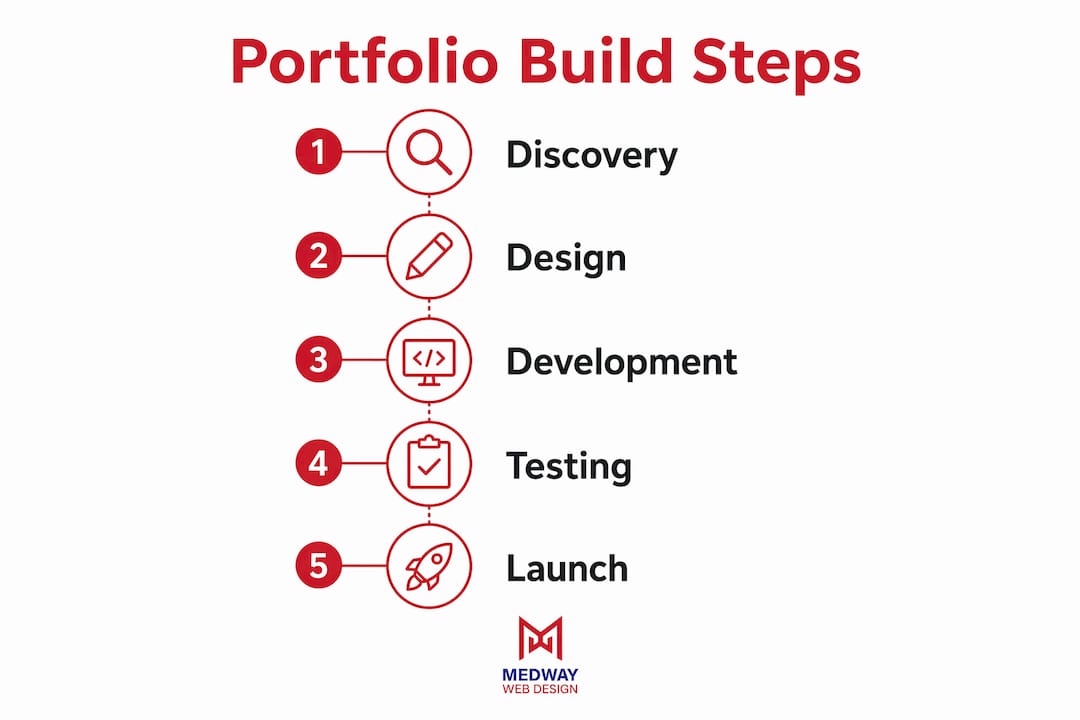
A professional custom portfolio build in the UK follows six phases. Durations below assume a small-business project of moderate complexity.
| Phase | Typical duration | What is delivered |
|---|---|---|
| Discovery | 1–2 weeks | Brief, audience research, sitemap, technical specification |
| Design | 2–4 weeks | Wireframes, UI mockups, prototype |
| Development | 3 weeks | Coded site, CMS integration, animations |
| Testing & QA | 1–2 weeks | Cross-device testing, Lighthouse audit, accessibility checks |
| Launch | 1 week | DNS migration, performance baseline, analytics setup |
| Ongoing maintenance | Monthly | Updates, security patches, SEO monitoring |
Cost drivers that push a project toward the higher end of the £3,000–£15,000+ range include WebGL or Three.js animations, bespoke CMS configuration, third-party integrations (CRM, booking systems), and multi-language requirements. A standard quote should include wireframes, WCAG accessibility checks, Lighthouse optimisation, CMS training, and at least 30 days of post-launch support.
Which technical stack is right for your interactive portfolio?
Stack choice affects cost, performance, and who can maintain the site after launch. Three options dominate for UK small businesses:
- WordPress with custom themes / Gutenberg blocks: Familiar CMS, large developer pool, strong plugin ecosystem. Best for businesses that need frequent content updates without developer involvement. Performance requires careful optimisation; heavy page builders can harm Core Web Vitals scores.
- Webflow: Visual development environment with clean output code. Excellent for design-led projects where the client wants CMS control without a developer on retainer. Hosting is managed; export options exist if you later want to self-host.
- Next.js / React (headless custom build): Maximum performance and flexibility. Pairs with a headless CMS such as Sanity or Contentful. Best for complex interactions, high-traffic sites, or businesses that anticipate significant feature expansion. Higher upfront cost and requires developer involvement for updates.
Specialised animation libraries such as GSAP and Three.js unlock the most sophisticated interactions, but they increase labour and demand device-adaptive rendering strategies to preserve performance on lower-end mobile devices — dynamically reducing render resolution or capping frame rates where necessary. The website speed optimisation checklist covers the Core Web Vitals targets your agency should commit to in writing.
Accessibility checklist for your brief:
- Keyboard navigability for all interactive elements
- Sufficient colour contrast ratios (WCAG AA minimum)
- Alt text on all images and media
- ARIA labels on custom components
- Screen-reader testing before sign-off
Pro Tip: Ask every agency to provide a pre-launch Lighthouse report with scores for Performance, Accessibility, Best Practices, and SEO. A score below 85 on any metric warrants a conversation before you accept the build.
How should you structure portfolio items to drive enquiries?
Each portfolio item is a micro-conversion opportunity. The most effective structure follows a four-part case-study template:
- Challenge (50–80 words, one image): State the client’s problem in plain language. Avoid jargon.
- Approach (100–150 words, process visuals or annotated screenshots): Explain what you did and why. This is where expertise is demonstrated.
- Outcome (50–80 words, metrics): Quantify results where possible — traffic uplift, conversion rate improvement, time saved.
- Call to action (one sentence + button): “Working on something similar? Let’s talk.” Link directly to your contact or enquiry form.
KPIs to track from day one:
- Enquiry rate (enquiries per 100 sessions)
- CTA click-through rate on case-study pages
- Average time on case-study pages
- Micro-conversion events (video plays, document downloads, filter interactions)
- Core Web Vitals scores (Largest Contentful Paint, Cumulative Layout Shift, Interaction to Next Paint)
Set up Google Analytics 4 event tracking for each CTA and micro-conversion before launch, and record a baseline from any existing site so you can measure improvement accurately.
What questions should you ask a web design agency before signing?
The quality of an agency’s answers to these questions predicts the quality of the final site more reliably than their portfolio alone.
- What is your documented process from discovery to launch?
- How do you test for WCAG accessibility compliance, and at which stage?
- What Core Web Vitals scores do you commit to in the contract?
- Who owns the code and hosting after launch?
- What does post-launch support cover, and for how long?
- Can you provide two or three client references from comparable projects?
Red flags to watch for: no documented process, vague or absent accessibility commitments, performance targets stated as aspirational rather than contractual, and unclear ownership of the codebase or hosting environment. An agency that cannot explain how it measures success before launch is unlikely to deliver measurable outcomes after it.
Pro Tip: Use an RFP template to structure your agency brief formally. A written brief reduces scope creep, aligns expectations, and gives you a reference point if deliverables are disputed.
How MedwayWebDesign approaches interactive portfolio builds
MedwayWebDesign begins every project with a discovery-led brief: understanding your audience, your competitive context, and the specific outcomes you need the site to drive. Design is prototype-led, with wireframes and interactive mockups reviewed before development begins, so changes are made at the cheapest possible stage. Development is performance-first, with Core Web Vitals targets set at the outset and verified by Lighthouse audit before launch.
CMS ownership is transferred to the client at handover, with training included as standard. Post-launch support covers security updates, performance monitoring, and content assistance. For businesses considering investor-facing or high-credibility portfolio sites, MedwayWebDesign’s investor-ready website guidance provides a useful frame for what the site needs to communicate.
To start a project, MedwayWebDesign typically needs: a one-page brief, three example sites you admire, and a budget range. That is enough to scope the project and provide a realistic proposal.
Key takeaways
A custom interactive portfolio website, built to WCAG standards and optimised for Core Web Vitals, delivers measurably better enquiry rates than template alternatives for UK small businesses with competitive positioning requirements.
| Point | Details |
|---|---|
| Custom vs template decision | Choose custom when brand distinctiveness, CTA control, or immersive interactions are required; templates suit simple showcases only. |
| Realistic UK cost range | Custom builds typically cost £3,000–£15,000+ depending on animation complexity, CMS requirements, and integrations. |
| Performance and accessibility | Require Lighthouse scores above 85 and WCAG AA compliance as contractual deliverables, not aspirational targets. |
| Case-study structure | Structure each portfolio item as challenge, approach, outcome, and CTA to maximise enquiry conversion. |
| MedwayWebDesign | Offers discovery-led, performance-first custom portfolio builds for UK small businesses, with CMS training and post-launch support included. |
Why the custom route is worth the investment
The conventional wisdom that a polished template is “good enough” for most small businesses underestimates one thing: the conversion gap. A template constrains where your CTAs live, how your case studies are structured, and how your brand differentiates at the moment a prospective client is deciding whether to contact you. Those constraints are invisible until you measure enquiry rates against a properly engineered alternative.
The businesses that see the sharpest return from a custom interactive portfolio are not necessarily the largest. They are the ones with a clear brief, measurable goals, and an agency that treats performance and accessibility as engineering requirements rather than afterthoughts. The stack matters less than the process behind it.
MedwayWebDesign: start your portfolio project
MedwayWebDesign delivers custom web design for small businesses that need a portfolio site built to convert, not just to impress. The service covers interaction design, performance-first development, SEO optimisation, and ongoing maintenance — everything from discovery brief to post-launch support in a single engagement.
To begin, send a one-page brief outlining your sector, three example sites you admire, and your budget range. MedwayWebDesign will return a scoping proposal within five working days. For a broader view of what a professional web project involves, the small business web design guide covers the full commissioning process from brief to launch.
Useful sources and further reading
- Awwwards portfolio examples — the strongest curated reference for interactive storytelling and visual polish; use for inspiration before briefing an agency.
- Gallereee interactive portfolios — focused specifically on interactive portfolio examples; useful for identifying which interaction patterns suit your sector.
- Bolt.new portfolio builder — best for rapid prototypes or placeholder sites while a custom build is in progress.
- Flipsnack digital portfolio — practical for converting existing PDF case studies into shareable interactive documents.
- Creative-Folio on GitHub — technical reference for Three.js and GSAP implementations; relevant if you are evaluating the engineering complexity of immersive interactions.
- MedwayWebDesign investor-ready guide — detailed guidance on building credibility-first portfolio sites for high-stakes audiences.